Showing posts with label Functions. Show all posts

Tuesday, February 14, 2012

Graphs of Other TRIG Functions

Graph of the tangent function


Here is the graph of y=tan x. Note that there are vertical asymptotes where the denominator of tan x equals 0. So when cos x=0.


Graph of the Cotangent Function


Here is the graph of y=cot x. We now must consider where sin x equals zero because this is where you will put the vertical asymptotes.


Graph of the Reciprocal Functions (y= sec x)


First of all, here is the graph of y=cos x.

-Using reciprocal identities, we can draw y=sec x.

Graph of the reciprocal Functions (y=csc x)
Add Image


The graph in purple is y=csc x. The graph in red is y=sin x.

Monday, January 23, 2012

2.5 The Fundamental Theorem of Algebra

The Fundamental Theorem of Algebra:

If has a polynomial degree of , the number of zeros is also


Conjugate Pairs:

and


Finding a Polynomial with Given Zeros:

Example:


Thursday, December 15, 2011

Combinations of Functions

Combinations of Functions:

All of these are Arithmetic combinations of functions

Let f(x) =2x+3
let g(x) =

Creating new functions - examples

(f+g)(x) =f(x)+g(x)

=2x+3+

(f-g)(x) =f(x)-g(x)

= (2x+3)-( )

= -+2x+3

(fg)(x) =f(x)*g(x)

= (2x+3)( )

= 2+3

(f/g)(x)= ------> don’t forget to find the domain after dividing!

Remember-denominator cannot be zero!

= (2x+3)/( )

Wednesday, December 7, 2011

Domain and Range of Functions, Difference Quotient


Domain = all possible x-values
Range = all possible y-values


Domain

When finding the domain, check for:


  • negative square roots

  • denominators that equal zero

Examples


1.) In equations with fractions, the domain is determined only by the denominator. It is important to make sure that it will not equal zero.


Start by setting the equation equal to zero and solving.


These are the values that will make the denominator equal zero, so the domain of the function is all numbers except 2 and -1.


2.) In equations with a square root, it is important to make sure that we are not finding the square root of a negative number.


To start, set the equation as greater than or equal to zero and solve.


This is the lowest x-value that can be used before the equation becomes negative. Therefore, the domain of the equation is all values equal to or less than three halves.


Range


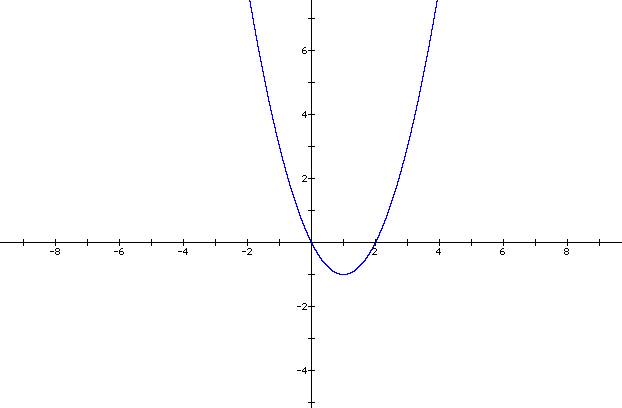
To find the range, graph the equation to see all the different y-values.


In this example, we can see that the lowest y-value on the line is -1, and that the lines extend upwards indefinitely.


Therefore, the range is


Difference Quotient


http://www.youtube.com/watch?v=1O5NEI8UuHM

Tuesday, December 6, 2011

Ch1- Functions

Function- f from a set A to a set B is a relation that assigns to each element x in the set A exactly one element y in the set B. The set A is the doman ( or set of inputs) of the function f, and the set B contains the range ( or set of outputs).

Functions can be expressed Verbally, Numerically, Graphically, and Algebraically
Use the vertical line test to check if there is a function on a graph. If the line passes 2 points then there are two of the same x values, therefore it is not a function.


Function Notation-
y is a function of x
y = f (x) ↔ The point (x, y) is on the graph f

Example- f (x)= 3x+10
f (2)= 3(2)+10
f (2)=16